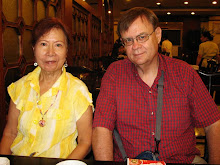
We wanted to use our new tea tray and our new gongfu tea set so we decided to have a tea tasting party. Of course, we invited Tom for a Sunday afternoon tea tasting. In addition, I sent an email to my older brother in Oklahoma with an invitation to join us. More just to let him know what we were doing than anything else.

Using Apple Mail, I developed my own invitation template to emphasize tea and sent out the invitation that went over 10,000 miles away. Needless to say, my brother did not show up for the tea tasting.

Tom showed up for the party at exactly 1400. We had already set up our tea service tray on the coffee table in the living room. I had laid out all the utensils and the tea. Actually, I laid out a bunch of tea just in case we got diligent in our tasting. I had only planned for five teas with a couple more greens if we had the time. Tom reads over the steps for a Chinese Culture Tea Tasting that I copied from the internet.

Here Sunee prepares all the cups and pitchers and teapots for our first official Chinese Tea Tasting. We had bought a couple of pounds of cookies which we could munch on as the party went forward.

Here Sunee heats the cups and gets them set up for the ordeal. Since I had already done a tasting of the fine Yunnan Golden Tip or Bud Black Tea, I did not take any photos of it except when Tom drank some. We started with this tea because it was not overpowering and was very smooth and easy to drink.

Tom agreed that it was as good as advertised.

Next up was the Puerh Tuocha that we had purchased last summer in Yunnan. I had also already tasted this and registered it in this blog so I did not take a lot of pictures.

The Tuocha performed wonderfully, giving us three or four solid steepings which we drank with enthusiasm. I asked Tom to describe the taste and he responded that it reminded him of a damp forest with the smell of woods and earth. Each steeping provided the same sensation with the second being the best. This puerh was smooth from beginning to end, front to back. I, once again, felt my face go a bit numb as the tea took effect. I like puerh very much.

Normally the Tuocha puerh is of lower quality, has a lot of dust in it and tends to be smooth but a little lacking in excitement. Not so the loose leaf puerh we had purchased in Chengdu. Here Tom takes in the aroma of the leaves before we begin the "gongfuing" of the tea.

Following directions from the internet concerning a tea tasting, we also felt and looked closely at the leaves, noting the size, color and texture. Of course, we had no idea what we were looking for or looking at, but we were tea tasters for sure!

Sunee prepares the tea and pours the first steeping of this fine tea using the Gongfu method.

The puerh is beautiful in this first steeping. The color is dark, deep with orange overtones. It was as good as it looked. At first, we had hints of wet woods and earth and something else we could not quite get. Something that was familiar to us but . . . we were not quite sure.

Sunee prepares the second steeping and then leaves us to go work on her Chinese watercolor painting.

Tom continues with this second steeping, leaving the steep for a couple of minutes longer than the first. This second steeping absolutely blew us away. Both Tom and I said, "Tobacco!" at exactly the same time. This puerh felt, tasted, or whatever one calls it like a fine, expensive Cuban cigar. Now we are wondering if one can call it "cigary?" Such a cigar has a sensation that one has to experience to understand. As the smoke fills the mouth, the tongue and roof respond with unique sensations like no other. This is exactly how our mouths were reacting to this tea. Cup after cup, we enjoyed this really unique feeling and relaxed and talked about cigars and this puerh tea. Both of us were enjoying our first official Chinese Tea Tasting.

As we drank our "cigary" puerh tea, we talked about puerh and I showed Tom my two cakes I had bought recently in Chengdu. I shared what little knowledge we had learned and suggested that these puerh cakes may be a decent investment to take back to the States whenever he decided to return. We plan to get a few more to take with us back to Thailand in January.

The third, fourth and fifth steepings, although the time increased for each, were equally as good and satisfying as the second.
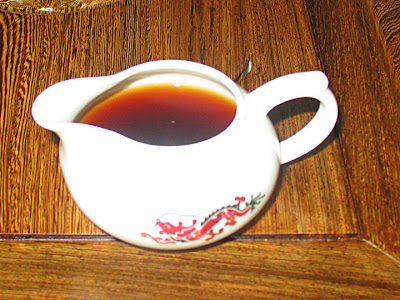
This is the fifth steeping and it was just as beautiful and just as "cigary" as the previous. We discussed the cost per serving of this fine tea and decided that it was probably cheaper than the others even though we had paid a lot more for it than the others. Puerh is a great tea to drink and it is supposed to be one of the healthiest teas to drink as well.

During the sixth and final steeping of the puerh, Sunee returned with her recently finished watercolor painting to show Tom. She has gotten to be very good in her paintings as you can see.

Time for a change. I had this Hong Xiang Fei Scented Green tea and wanted Tom to try. He does his smell, look and touch thing as all good tea tasters are required to do. This tea is one strange looking tea. The tea is rolled into little balls with brown looking stuff on the outside. It looked very much like rat or rodent droppings, a big rat or big rodent to be sure.

With this tea, I became lazy and used our teapot from Taiwan. After around two minutes of steeping, we poured our first shot.

The tea turned out to be weak so we decided to do it again by pouring it back into the basket for a few more minutes. We then discussed what we had experienced. Tom thought it had hints of rose or some other flower but he could not be sure. I could not make out the fragrance because my stomach felt a bit odd. I had not liked this tea when we first tried it and my feeling probably would not change this time.

The second steeping screamed at us "ROSE!" and my stomach returned the scream of "ACID!" Tom, however, liked it and finished it off. Me! I went to get some Zantac to stop the heartburn. This tea is not for me! We both decided that it tasted like year-old rose potpourri that had been left in my grandma's easter hat box for at least a year. I hated the smell and the taste.

Tom emptied the used leaves into one of the cups so I could take a picture of them. Do they look like tea leaves to you?

Here Tom finally gets one of the balls to open up into a definite tea leaf. It looked to be a very young leaf but who am I to know what is young and what is not! I ended up giving the Hong Xiang Fei we had left over to Tom. At least, he will drink it.

Our final tea would be the Emei Mountain Yin Zhen Yellow tea I have already tasted for this blog. I wanted Tom to try it and see what his reaction would be. Here he loads the gaiwan up with the yellow tea. He, of course, did the aroma smell, long look and feeling beforehand.

He was unsure of the amount of tea he should use so he filled it about half full or so.

The washing of the white heron, or so the Chinese saying goes for this step. Making sure the unwanted impurities are washed away.


The above steps are carried out with precision and we let the yellow tea steep for several minutes.

Here Tom pours the first steeping as I anxiously await this unique yellow tea.

Here is the first steeping and I thought it looked a lot darker than when I had made it before. The yellow was very deep and strong looking. One sip and Tom and I both let out a yell. Astringent is the correct word, but we both said WOW!. Too many leaves and too long brewing for sure. Eventually we did a second and third steeping and they were both perfect. It is difficult to describe this tea. It starts out with a bitter feeling (not really a taste) and then changes flavors or tastes depending on where it touches the tongue. Strange but wonderful sensations as we held the tea in our mouths. The aftertaste was definitely there, a bit sweet and a little bitter but not unpleasant. We may have made a mistake by not rinsing our mouths out after the first cup but I doubt if the sensations would have changed much. This tea is complicated, interesting and very pleasant. I can only imagine what the Jun Mountain Yun Zhen yellow tea would be like. It is listed as one of the top ten teas in the world. We plan to find some when we travel to the Tea Culture Town next month. Could get some at the local department store but I truly doubt if it is the real thing based on what I have read about it.
This yellow tea was a great way to finish the tea tasting. Luckily we started with a smooth and single taste tea and finished with a very complicated and complex tea. Our first tea tasting would have to be considered a great success. Now when to have another one?

 This is the most expensive Da Hong Pao we bought. We had the store put them in little individual bags which is quite common in most of the area tea stores in Emei City.
  The leaves are dark and tightly curled. This seems to be typical of Oolong teas all over China. I wonder if one can really tell if a tea is a Oolong just by looking at these leaves. I would say one probably could.
 This is a cheaper version of Da Hong Pao. Quite frankly, I could not really tell the difference between the two. This seemed to have less tiny pieces than the more expensive but this is probably because it was taken from a jar with a lot of teas and the flakes and dust were probably on the bottom of the container.
 A close up reveals the texture of the dark orange colored tea leaves. Again, I could not see any great difference between the two teas. Sunee fixed herself some of the cheaper brand and let me taste it. The Da Hong Pao I was drinking definitely had a stronger and more distinct flavor but is it worth the difference in cost?
 The first infusion (steeping) came out fairly strong with a bit of astringency but not bad. The "floral" taste must be the woody or earthy taste I experienced. Now that I think about it, I can taste the hints of floral but it is a quasi-floral with no distinct tastes coming to mind. The astringency part was probably because I let it seep a bit too long before drinking it. Nothing as astringent as we experienced with our yellow tea, however. This was not altogether unpleasant.
  This is the third infusion and it remains consistently "floral." The taste is a bit stronger than the Guan Yin Wang I tasted yesterday. The floral taste was much more floral in the later infusions. This is a great tea for special occasions. It is not cheap by any standards. Even the mid-priced Da Hong Pao was, for our small pocket book, quite expensive. I can see why this is considered in the top ten best teas in China. It is time to make plans to visit Fujian and find out where this tea comes from. It should be a great trip, don't you think?
 These are the wet leaves after three infusions. I ended up using the tleaves another four times before discarding them. Probably could have gotten another two out of them if I had pushed it. Kinda makes the tea not so expensive after all.
  Just to prove that the tea came from a Da Hong Pao tea bag. The bags were small, just enough for a gaiwan.