Friday, May 15, 2009

Green Tea Semi-Marathon Tea Tasting

We scheduled a tea tasting to give the Gap Guys one last opportunity to share their ability to taste and develop the "qi of cha". Unfortunately, Tom was sick with an ear infection and John was being stalked by several of the young students he had met at the University. Made for a short but enjoyable tea tasting.

In addition, we had to attend the closing ceremonies for the ongoing English Culture Week. One of our students was going to take part in the opening of the singing contest as a guest singer. Seven finalist meant the opening duets needed an extra. She was the only member of the Foreign Affairs Department to take part in the singing contest. The winner of last semester's contest, our own Giselle, opted out as she was preparing for the finals of the Sichuan-wide speech contest. Other talented members also decided not to participate. We also found out later that Mr. Yao had been the official translator for one of the VPs who closed the week.

Anyway, here is the report from our last tea tasting with the Gap Guys.


We set up our Chinese Tea Service set on my desk which gave us a bit more room to enjoy the tasting. The plan was to do as many greens as we could. Things never turn out as one expects.

John insisted on taking a picture of one half of my now fully stocked tea cabinet. Do you think that my wife and I are serious about tea? She also has a corner full of tea that we plan to send back to Thailand when her family comes to visit us in September. Most of that is Yunnan Dian Cong, Golden Tips and lots of Puerh Beeng Cha.

The three tea stalwarts pose for the beginning of what we hoped would be a green tea tasting marathon.

The first tea was the Ying Bin Cha or welcome tea. I have been looking all over the internet to get information about this tea. "Welcome Tea" is what the wholesaler in Kunming called it. I think it is simply the traditional tea that Yi people in Yunnan Province and elsewhere offer their guests when they first arrive. It is part of the traditional "three tea" ceremony in the Yi culture. First the welcome tea, then the "let's talk and have a good time" tea and, finally, the "sorry to see you go." Hey, it sounds good to me. There really is a three-tea ceremony of the Yi. I am just not sure what kind of tea they use. The information I wrote down in Kunming just stated that it was a traditional welcome tea.

Here I am checking out the "welcome tea." The liquor appeared to be a green tea with nothing to distinguish it from a Yunnan blended green tea. I tried but I found very little to like about it other than as a remarkable green tea.

John received his "welcome tea" with the same dexterity as before. We all open this tea tasting with a hearty "WELCOME ONE AND ALL."

John gets the same reaction as I did with this tea. A weak and mild tea. John, however, in his unusual ability to taste the essence of tea, suggests that it is not really from the tea plant but a herbal tea. He does not think it tasted anything like a tea.

Dave takes this unusual picture that really shows off the beauty of one of the tea cups I bought in Yunnan. We discuss the possibility that John brings up.

All of us then check out the dried leaves once more to see if it is a herbal tea. Here is a picture of the dried leaves. We all concluded that this was, indeed, a herbal tea and not a real tea.

Dave shows his disdain for this herbal tea. He says it is uninspiring while I added that I would never again welcome any guest to my home with this tea.

While taking pictures, John also takes another good taste and agrees with our assessment.

Finishing the herbal "welcome tea."

A stalker calls John and takes him out of the tea tasting "game" for several precious moments. It is obvious that we have lost him as a viable taster of fine teas. This continues through the late afternoon until we are forced to shut things down and attend the singing contest.

We next do the Zhu Ye Qing green tea that Dave had brought from Mengding Mountain near Ya'an. He had gone there with Robert and had found a plantation that offered Zhu Ye Qing. They had tried the best and it was marvelous. The tea that Dave had given me was not the top quality but was probably number two. Our goal was to compare it to a top quality Zhu Ye Qing from Emei Mountain.

Here John, get off the phone and try this fine quality green tea from the number one tea green mountain in all of China - Mengding Mountain..

John forced the stalker to hang up so he could try this Mengding Zhu Ye Qing green tea. He liked it as he sits back and enjoys its "qi." A full-bodied "qi" he quips.

Dave agreed that this was a good green tea with a lot of "qi."

The Mengding Zhu Ye Qing has the familiar yellow green liquor found Zhu Ye Qings from Emei Mountain. Beautiful color!

Next up is a top quality Zhu Ye Qing from Her Majesty - Emei Mountain. This tea as given to me by the University for my work getting ready for the CCTV Speech Contest last month. People do not go to the trouble of putting cheap tea in expensive little bags like this. This stuff was expensive!

John is given the honor of trying the first cup of Emei's finest. He was not disappointed. This tea could very well be the world's finest green tea.


Dave frantically takes notes on what we think of this Zhu Ye Qing. He, too, has an inner feeling that we are enjoying the world's finest green tea, or at least the finest green tea that the likes of middle class working stiffs like us could afford.


Emei Mountain Zhu Ye Qing in all its golden green beauty. Simply the best.

To get John away from his stalker machine (cell phone), Dave and I insist that he take over the Tea Meister's slot. Here I explain the fine art of tea processing.

With confidence way beyond his years, John proves to be a novice expert at tea processing. as he pours all of us some fine green tea we picked up in Chuxiong - Bai Zhu Shan Lu Cha or White Bamboo Mountain green tea.

The stalkers do not leave John alone and we are only able to do this one last green before it is time to head out to the final installment of English Culture Week.

Before we head out, we take some much needed sustenance in the form of cookies. These are now a tradition at our tea tasting parties.

In addition, Sunee brings us some dumplings that she has unfrozen and prepared for us. They are inexpensive, convenient and very TOM DELICIOUS!

Hey do they look like this:

Notice the comment below from someone probably from Russia. I saved the recipe for these Russian dumplings and they are, indeed, very similar.

We closed out this tea tasting early because of the constant stalking of John and the start of the singing contest. Soon the Gap Guys will be back in England. Hope they carry on the tradition of tea tasting.

Tuesday, May 12, 2009

An Invitation To An Evening of Tea Tasting

Tuesday, April 28, 2009

Another Day, Another Tea Tasting Party Planned

The Qi Of Tom


Another day, another fun activity

Dedicated to the tree of desirability

We know all about this kind of tree

The tree that brought us all our tea

As we sat here with our open pot

We hoped to get our tea real hot

Dear Tom did work his magic great

And provided us with tea first rate

We heroes great were on his side

He filled our cups with speed and pride

With water hot and the qi of tea

We waited for him in solidarity

Tom did his thing both quick and true

And made us all one great brew

It was from Emei our mountain near

Twas Zhu Ye Qing the green so dear

We filled our cups not once but thrice

And drank them down at Tom’s advice

We were all experts in the qi of tea

Except for Tom, as we all could see

Tom cried out loud for the qi to come

His cheeks were red and his body numb

He poured his tea and we saw him frown

He bit his lips and swallowed it down

The tea passed down his anxious throat

At first a silence then a rumbling note

The qi began to flow into Tom’s sad face

His head spun around and his heart did race

The qi was strong in Tom this day

He is now one of us all the way

Saturday, April 18, 2009

Searching for the Key (钥匙) to the Qi of Cha (茶气)

Invitation to a tea tasting.

We scheduled an official Chinese Cultural Tea Tasting Party for 17 April 2009 (Friday) at 1800. I sent out official invitations to the participants (to include my brother in Oklahoma and John, a former teacher here who now lives in Guizhou Province). Participants were Tom, Dave Bishop (Gap Guy #1), John Whale (Gap Guy #2), Ivan (Gap Guy #3 doing his thing in Leshan down the road) and me. Tom was the designated Tea Meister as he had been practicing for the last two weeks to get things right. Tom also dressed the part as he wore is new Chinese white silk shirt which put the rest of us to shame.

We were in search of that elusive energy force we had heard about - Qi. In my research, I had read articles about how tea brings with it this Chinese Qi and many writers often described the Cha Qi they experience in drinking their tea. Why not us? Why not channel the forces of the tea for us in our own special tea tasting ceremony?

The Chinese Tea Ceremony's Seven Steps and what each step means.


The Qi of Tea movie poster starring the five great tea heroes of Emei Mountain.

Ode To Cha Qi

When we five heroes came, we drank our tea hardcore;
No matter how much we drank, we always asked for more;
The table was set to search the world for this thing called qi;
We sat around and philosophized about this drink called tea.

We guests, heroes one and all, drank from cups so fair and small.
The greens came first, two dragons involved in a battle brawl;
The Chengdu one , bought with cash, was the one we qi’ed about,
But both were great and gave us qi of which we were without.

When Ivan and John took the tea, they rolled upon the floor;
John smiled his smile of complexi-tea and quickly asked for more.
Ivan, drinking his stupidi-tea, grasped hard upon the chair,
And as he looked at all of us, he understood this qi affair.

The qi took charge as our visions dimmed, it must have been the tea
For Dave began to wax and wane about things that only he could see.
We tried to calm him down a bit, but nothing seemed to work
He crawled upon the table and quietly went berserk.

Poor Tom our tea master, saw us all heading south,
And wondered how it was, for his tea was in his mouth.
He’d tried to swallow several times, but all to no avail,
And now that the qi had come, he hoped he would prevail.

The qi was now inside of us and all around the room.
The tea had brought it on and now it spelled our doom.
Ole Cecil was dancing high, way up in a big white cloud;
The qi had taken him way up there and he was getting loud.

Poor Tom still could not drink his tea, it simply wouldn’t go,
So he never really experienced how the qi did flow.
He gathered up the four of us, and took us all outside;
He kicked our heads and faces until the qi did subside.

When we five heroes went back in, we drank our tea hardcore;
No matter how much tea we drank, we always asked for more.


The five famous and great tea heroes of Emei Mountain search for the key to the Qi of Tea.


The tea set up was meticulously laid out for efficiency and professionalism. No one could say that we did not have the right tools in our search for the Qi of Tea.

Tom, the Tea Meister, prepares the equipment and tools to start the ceremony. He was most anxious to feel the Qi as quickly as possible.

Our first teas to be tasted were the most famous in China, two different Longjing greens from the Hangzhou area. The first came from the Chengdu Tea Culture Street and the second was given to me by Grace Spright one of our students. She claims to have gone right to the source and bought this tea from the processor himself. We called this the battle of the dragons or dou cha ( 斗茶 ) - tea fight. A competition of tasting different teas to establish which is the best. Of course, we were tasting what was supposed to be the same tea. My research has revealed that many teas from the Hangzhou area are now called Longjing but only the real one comes from the original plantation on Lion Head Mountain. I must find out the exact location where Ms. Grace purchased this green tea. Here Tom shows the heroes the leaves of the Longjing green prior to pouring the first cups.

The first cup of Chengdu-bought Longjing green tea goes to Dave who smiles in "brilliant" anticipation of gaining access to this teas "qi." His excitement was palpable and almost embarrassingly overwhelming.

Here John portrays his normal oblique self-expression of Asian inscrutability. Notice how deftly and passionately he handles the newly purchased tea cups I bought specifically for this ceremony. John, of course, prefers any liquid to tea (especially water) but because of his Asian background felt obliged to enter into the halls of fame and heroism to observe this thing called "Chinese qi." Is his smile the wry smile of Asian amused condescendence or simply the obligatory politeness so often formed on the lips of his ancient ancestors?

Casually, Tom introduces the concept of sipping tea. Most westerners have no real understanding of what "sipping" entails. As an inveterate sipper, Tom provides needed depth to our understanding of how exactly one sips a Chinese Longjing tea to get the most taste from it and force the qi from its unwilling leaves. For Tom, sipping was easy. It was the follow-on swallowing that caused him great concern throughout the tea-tasting evening.

Time for the Grace Spright provided Longjing. After three infusions of the first Longjing and gaining enough experience from the process, we were all anxious to apply the rules of "dou cha" to this second Longjing. Notice, once again, the dexterity that John is applying to his tea cup. Also notice the "kung fu" stance of our great and masterful tea meister. I was led to believe that this stance brings out the "qi" of tea much quicker than just handing out the tea willy nilly.


Ivan jumps the gun on this second Longjing. He could not wait. He refused to wait. He glared at us with his nerdi-tea! He immediately scarfed the tea down in one gulp. Of course, Tom was shocked at this breaking of protocal. He spent the next ten minutes lecturing Ivan on the subtleties of sipping. Ivan was forced to sip slowly four more Longjing teas before he could join in our brilliant wordsmanship and philosophizing. He kept repeating to himself - tea is for sipping, tea is for sipping.

Dave, fully loaded with qi from this second Longjing green tea, begins to speak in a language that no one could understand - British English. Even John could not help but laugh at Dave's ridiculous accent. Tom, unawares of any language being spoken, had become involved with trying to swallow the tea. This was a constant struggle for Tom all evening. It was concluded that both Longjing teas were beyond reproach in their taste and the qi we received from them. We all agreed, however, that the Longjing tea I bought in Chengdu gave us a bit more of a "qi" kick than the one Grace had provided. Could it be that the Grace-provided tea had been unwilling to give us the full force of its qi and needed to be "aged" a few months more to discourage its beligerence? One will only know in two months time.

Qi was flowing amongst us and began to fill up the room to such an extent that I decided to slow things down by showing off my newly acquired Puerh Bing Cha that Jack, one of our students, had given me for my birthday. We are talking a serious bing cha (puerh pressed tea cake) here. The box was beautiful and the cake smelled wonderful. It took me more than fifteen minutes to wrestle this tea back from Tom's grasping hands. He kept insisting that we try it since he had been unsuccessful in swallowing the Longjings and thus sat as an empty vessel on his chair with nary a qi to be seen in or near him.

We also took a break and shared some cookies amongst us to slow down the rapidly expanding qi that most of us had begun to feel. Tom, however, felt nothing but contempt and thus was eager to eat the cookies to hide his inability to drain the qi from his tea.

video

We witness the full effects of the Qi as Dave passes out the cookies. Strange language!


Our next "dou cha" was between the yellow tea from Emei Mountain and the yellow tea from Jun Mountain in Hunan province. Both were called "silver needles" or "yin zhen" (银针). The Emei Mountain tea I had purchased several months ago from a local department store and had tasted it once with Tom. It was ok but nothing really great. The Jun Shan yellow tea I had purchased on our last trip to the Tea Culture Street in Chengdu. Here Tom examines both teas to see the differences. There were big differences to be sure.

Tom then allows all of us to smell the Jun Shan tea. This, of course, is testing the aroma to see if we could get a little qi going prior to drinking the tea. John takes a whiff and denies knowledge of any aroma, even though some of the tea stuck to his uncharacteristically none-Asian nose.

Dave gets some qi quickly and refused to quit smelling the aroma. Tom had to threaten him with "remedial sipping class" to get the bag back. Pouting, Dave, immediately goes back to his version of the English language which only he could understand. We all figured he was bad-mouthing us but none of us could really be sure.

One whiff of this yellow tea sends Ivan into Lala Land (as if he ever left there in the first place). Tom was quick to retrieve the bag of yellow tea before Ivan could eat it. In Lala Land, eating tea must not be thought of as immoral nor in bad form.

Here Tom is pouring our first infusion of the Jun Shan Yin Zhen. Because the gaiwan had grown a bit from handling to0 much of the qi from the tea, Tom needed some help to get the tea poured. No problem as Dave was willing to assist this delicate operation even though no one could understand what he was saying.


Tom proudly shows off his successful pouring of the yellow tea. He also spent ten minutes admiring and telling us how yellow the tea was. None of us were blind, yet that did not stop Tom from his pontification of the yellowness of the tea. The tea was, indeed, yellow.

Since we were all tired of watching John passionately grasp his tea cup as he got his tea, Tom decided to give the first cup of Jun Shan Yin Zhen to Dave. This was done mostly to quiet Dave down so we would not have to listen to the strange noise coming from his mouth that he kept claiming was English. Of course, Tom conned him into thinking that it was because of John's constant hotdogging in grasping his tea cup.

Ivan breaks away long enough from Lala Land to get some of the Jun Shan yellow tea. Here we see him concentrating on getting back to Lala Land. Does he live in Lala Land all the time or is it the qi of the tea that sends him there? None of us could really quite figure out how he moved between reality and Lala Land so easily.


As you can see by this picture, Tom, our Tea Meister, is doing an excellent job of not wasting any of the precious qi coming from the tea. His professionalism was astounding but we all felt remorse at his inability to swallow the very tea he was meistering.

Here Tom is carrying out the pre-dou cha ceremony where we are shown the two opposing teas. The Jun Mountain silver needles knocked the locally grown Emei Mountain silver needles yellow tea out of the ring. There simply was no comparison of the two teas. The Emei Mountain tea looked more like grass whereas the yellow tea from Jun Mountain looked exactly like the pictures I had found on the internet. Fake verses real. Real verses fake. Not even close!

My own cup of Jun Shan Yin Zhen. One can almost feel the qi as it floats up from the yellow liquid. This tea is great! We all had positive things to say about it and spent an unusual amount of time singing its praises.

Our dou cha was interrupted with a beautiful four-year old mini-tuocha that Sunee and I had taken from the hands of a dealer in Kunming two weeks previous. The dealer offered us fifty of these little jewels for 80 Yuan. As we were tasting it and deciding to buy it, he mentioned that we could get 150 of them for only 150 Yuan. A deal is a deal wherever one finds it so we bought the larger can of these marvelous little tuochas. We loved them in Kunming and the five heroes loved them on the slopes of Emei Mountain. This was the best tea we tasted all evening.

Isn't the dexterity of John's grasping of the tea cup amazing? We all stopped talking and stared as Tom handed the puerh-filled cup to John.

His fingers nestled the glazed blue cup filled with tea.

Smooth, feminine-like graspings promising much no respite

To the cup so often held in the light for all of us to see.

Yes, John, yes! It seemed to squeal in pleasure and delight.


Tom answers a question concerning his method of extracting the precious liquid from the mini-tuacha as John grasps with pleasure the small delicate blue tea cup. Notice the glow of qi that surrounds John but seems to be missing from Tom. Once more, Tom's problems continued through even the puerh session of tea tasting.


Ah, puerh. Blessed puerh. All agreed that this was a wonderfully complex tea. We all sipped and took a shot at describing what we were experiencing.


Here is my cup of puerh. This was around the fourth infusion and it remained as dark and beautiful as the first. Talk about a steal! This tea was worth every bit of Yuan we had paid for it.


Amazing but true, Ivan returned to reality just in time to celebrate his first infusion of the puerh. Here he toasts the puerh with Dave. Ivan, a brilliant linguist in his own right, was actually able to interpret for the rest of us what Dave had said over the last few hours. It was also Ivan who most impressively expressed the exact adjectival nouns that applied to this puerh. Such words as "halibut" and "squidy-like" aroma breached the etiquette that Tom was so forcefully trying to maintain as our tea meister.

Infusion after infusion brought on many more of these Ivanistic adjectival nouns to our ears and minds. Here John fakes a sniff of the puerh to show off his now "celebrated grip" of the beautifully glazed blue tea cup. He was obviously sniffing just for the "halibut."

Another infusion. More sniffing. More Ivanistic adjectival nouns. This time it is "the dust of a Rhodesian wine cellar" that Ivan smells in his puerh. What a nose for sifting through the dictionary of his mind to come up with just the right descriptions for this puerh!

The words grate upon the human ear and test our fortitude

Ivan, dear, Ivan bring forth your royal chants of pictured phrases

Let us all travel down your path of words for puerh so crude

And smell the aroma you describe and never cease to amaze us.


Here Tom continues to wonder why he simply cannot swallow the tea he has so brilliantly prepared for us. As John smirks "qi'ingly" at the way the other heroes hold their cups, Tom looks wistfully at the dark orange liquid lying limpid in his cup. No see no qi, we hear him muttering to himself between his tea meistering.


Left alone on a plain of existence below that of the other four heroes, Tom desperately seeks the qi in the actual dried tea leaves. What is it that makes the tea hard for me to swallow? Maybe it is just not my "cup of tea" tonight, he rationalizes to himself.

"I have fully "grasped" the qi of tea," John states emphatically after infusion number twenty of the tuocha puerh. No one dared argue as we all stared at the incredible spectacle of his thin, flawless fingers gently, yet firmly caressing the beautiful blue glazed tea cup from Kunming. Notice the index finger defyingly pointing toward the obviously inferior heroes that sit on his right. How dare this sycophant to the qi of tea so insult his fellow heroes in this "sippingly" uncharitable way! So much for the obvious benefits of puerh.

Round three of our dou cha - Tailand oolong #17 verses the world champion of oolongs: Da Hong Pao or Big Red Robe. Here Tom introduces the wet leaves of the Da Hong Pao to his fellow tea heroes. Notice how Ivan turns his now enhanced respiratory system into a sniffing machine; capable of tracking and classifying even the tiniest hints of adjectival nouns.

Da Hong Pao, the legendary tea of Wuyi Mountain in Fujian Province, brings only an arrogant sniff from John. Maybe he has not been clued in on the brilliance of the tea. Maybe his claim to have obtained "qi nirvana" has caused his sensory perceptions to become lazy in his newly-gained status as the foremost hero amongst us lowly mortals. Perhaps, perhaps he remains a neophite in teadom and has been putting on a show to fool us into believing he has reached tea stardom.

Darth Dave reaches a new level of "qi'ness." Denied the use his facade of speaking English, he rapidly moved into a different plain of existence than his fellow heroes. His language had also accompanied him to this higher plain. No longer the language of the barbarian and unsociable Saxon hordes who punished the original inhabitants of the island we call England by forcing them into using the now modern weird and strange language of the Brits, the Darth man's language now consisted of heavenly "hum's and ha's" and a few angelic "mmm's."

Rising up as if already gone

The teamonger Darth Dave

Like a white and flying swan

Moves into the nirvana cave


Entering into the mystery of the qi

As all us poor mortals sit so near

He takes another swallow of the tea

Then floats away on qi to disappear


The Da Hong Pao experience reaches a personal level as I sip and enjoy my own cup. Here the amber liquid reminds one of apple juice squeezed by virgins intent upon gaining the last drop of their precious liquid from the fruit they have so patiently picked.

The Thailand Oolong Number 17 turns out to be but a footnote in our quest for glory and qi. Up against the finest oolong money can buy, it pails in comparison. On its own, it would have done very well. This last round turned out to be a fight between the adjectival nouned - 800 pound gorilla and a pleasant and beautiful bunny rabbit. The rabbit, sweet and affectionate as it may be, was squashed into oblivion by the 800 pound gorilla. And so it was with Thailand's best. A footnote that states that there was no contest and we, as heroes, were guilty of fixing the competition in the champions favor. Guilty as charged!

Tom Terrific ponders his role as our tea meister, reviewing the errors made and the triumphs won. We all agreed that the last dou cha was unfair and promised our "bunny rabbit" of a Thailand oolong a chance against a more worthy and equal opponent. The Da Hong Pao was one of our favorites along with the incredible puerh. The two green Longjings were also very noteworthy in their ability to supply us with a load of "qi."

John was voted into the heroes hall of fame for his rapid rise from obscurity to tea hound extraordinaire. Dave remains firmly entrenched as one of the top heroes. He could easily join John in the hall of fame except for his inability to speak modern standard English. His British dialectual English prevents most people from understanding his deeply moving and spiritual thoughts as interpreted to us by Ivan, the adjectival noun wizard.

As to Ivan? Until he approaches the 50% mark of living in reality, he is neither allowed into let alone near the hall of fame. Hero he is but he remains in the "twilight zone" somewhere between reality and his own personal Lala Land. He made great progress this evening in approaching that 50% benchmark with his brilliant translations of the "sayings of Darth Dave" and his accurate and telling descriptions of the tuocha puerh. A few more tastings and he most definitely will have a shot at the coveted hall of fame.

All good things must come to an end and here Tom bids adieu to his fellow heroes. His plans over the next few weeks prior to our next scheduled tea tasting is to practice his swallowing techniques. Thus, he too, will be able to enjoy the Qi of Tea with the rest of us.

The following are the results of our tea tasting as transcribed by Darth Dave:


video

We witness the full effects of the Qi.

Sunday, April 12, 2009

China Tea Travels To Yunnan For Tea (Naturally)

We left the Chengdu airport at around 9pm and arrived in Kunming after 10pm. By the time we got to our hotel (courtesy of the many touts at the airport) it was well past 11pm. We were hungry so we walked down to the only restaurant open and had some quick noodles.

The next day we took the early bus to Chuxiong, about two hours by express bus from Kunming. Unfortunately, we did not take the express bus and our journey last three and half hours through some very rough mountains and bad roads. Wrong bus station. Wrong bus.

After completing our business in Chuxiong we had the next day's morning to explore this small Yi minority town (see inchinahil.travellerspoint.com for more information on Chuxiong). The first thing we looked for was a tea shop and we found one in the middle of the town.


Chuxiong Tea Shop

As we entered this couples well-stocked tea shop, they were having their lunch and did not seem too happy to see us. As we visited and had them finish their lunch, they became friendlier. By the end of our visit, they treated us as if we were part of their family, visiting with us about the local tea and giving us advice on how to determine the quality of the tea we were drinking.

Tea ceremony, Chuxiong style.


The tea on the left is a standard blended green from Yunnan. The one on the right is a local tea from White Bamboo Mountain. The first thing I noticed was the cloudiness the local tea had.

This is a close up of the Yunnan blended green tea. We have tried several of the Yunnan greens and all were solid green teas and very drinkable. This one was no exception.


Package for the locally produnced White Bamboo Mountain green tea. This tea was supposed to be grown by Yi people, picked and processed by them. It looked a lot like Bi Lo Chuan.

Here is a close up of the White Bamboo Mountain green tea. It was very unusual and obviously unique so we bought some to give it a try. I will do a tea tasting of it in the near future.


While we were at this shop, we asked about a puerh that we had purchased in Chengdu. Remember the white or tippy puerh we had purchased earlier? Well, this guy had one and so we asked if we could try it. Both, Sunee and I were disappointed and decided against buying his tippy white puerh cake.


Yulin Puerh Tea Shop in Kunming


We went looking for an art house for Sunee to check out some art books and look at some paintings. There is never a tea shop we can pass by nowdays without going in. Here we found the Yintai Shop next to Green Lake in downtown Kunming. It is a tough life chasing tea in China.

Inside we found wonderfully stocked shelfs of puerh. This was a puerh shop after all and we were in Yunnan Province.

We ended up buying one of those golden cans filled with mini tuochas. It turned out to be a rare find when we tried it later on at Emei.

Two different kinds of puerh. The one on the left was the min tuocha we eventually bought. It was great!

A full service shop no less.


And here is our tea master who let us taste tea to our hearts delight. Of course, we rewarded him with many great purchases as well.


Looking For Yunnan's Best Gold

After spending some yuan at the puerh shop we decided to seek out my favorite tea - Yunnan Gold. We stopped at several along the lake only to be told they stocked only puerh. We then walked through the beautiful Green Lake Park and decided it was time to return to our hotel. That was when we found our Yunnan Gold.

The owner had the gold and was happy to let us try some. Seems she did not cut her gold with the normal dian cong but sold it straight. We had to believe her as the tea we saw was solid gold and the taste was even better.

Here the owner's daughter (I assume) fixed us up some of her Gold. Was it fine! Of course we stocked up on it.

Sunee negotiates with the owner so we can have lots more of the Gold when we get back home. She was successful and I was happy.

We also got to try some standard Yunnan green. Got lots of green in Emei so we passed on this tea. Took a bunch of Gold off her hands, though.

The Kunming Tea Wholesale District


Monday, March 30, 2009

A Tea House in the Nongyuan Artist Village of Chengdu

This past Saturday (March 28), we met Bogdan and his wife, Weiyan, in Chengdu and traveled to the Nongyuan Artist Village of Chengdu (see my emeimtn.blogspot.com) where we had lunch and visited for about three hours. As we walked through the beautiful setting, we came across a restaurant and tea house that were in the process of being finished. The tea house was open so we went in to check it out. The following pictures and information are about this very unique tea house set up for the resident artists.


A great "stash" of puerh on an antique Chinese medicine cabinet.

In addition to the main tea table in the front, the tea house had four antique looking tables with four chairs around the spacious and sunny room. Each table had its own tea server of different design and size. Here we see a tradition tea server carved from a single piece of wood with all the normal accessories.

This table had a very attractive tea server with coaster and hot water pot ready for guest to sit, relax and enjoy their tea.

A traditional Chinese tea server located near the windows with a beautiful view of the surrounding bamboo forests and flowers in the area.

Another table and another server. Again, this table afforded a view of the garden setting of the tea house.

A huge carved water buffalo gave an impressive feel to the main tea table located in the front of the tea house.

A second "stash" of puerh stood across the room from the first. Again, it was actually an antique Chinese medicine cabinet. What a great idea for storing one's precious teas!

One of the local resident artist welcomes me to their tea house with a great cup of puerh tea. The tea was really good with hints of floral and mushrooms.

A nice deep orange colored liquor made me feel welcome and warm toward the three artists who were enjoying a tea together.

These interesting tea canisters were filled with different puerh's from their collection, all ready to be brewed and enjoyed.


The tea house was beautiful and gave a feeling of warmth and friendliness that Sunee and I would like to replicate one of these days in our dream traditional Chinese compound we plan to build in Thailand.

Tuesday, March 24, 2009

Chengdu Tea Ceremony

This is a short Tea Tasting we had at the Chengdu Tea Culture Street. The two teas were Huang Ya from Meng Ding Mountain and Dragon Well Longjing. Both were great so we bought a little of both.

video

An Emei Mountain Chinese Tea Ceremony

This is a typical tea ceremony performed in tea shops and tea houses everywhere in Sichuan Province. This particular ceremony took place at a new Zhuyeqing Tea shop across the street from Southwest Jiaotong University in Baguan Village.


video

Monday, March 23, 2009

A Tea Presentation

This is the presentation I gave as an example of a "How To" presentation. The students are actually teachers from different departments who want to improve their English. They will have to prepare a simple "how to" presentation along these lines.

video

Thursday, March 19, 2009

Special China Tea Travels Hand-picked and Hand-processed Green Tea


As stated in the previous post, all the "hard work" put in by the Freshmen Class 1 came to naught because we had not picked enough tea to process. I ended up with the tea we had picked. I took it home in hopes of convincing Sunee to become a tea processor. She liked the idea and we became our own specialists in tea processing. The above poster represents our new found field of tea processing. Actually it came from a website that specializes not in tea but in what is called "motivational posters." How is this for a motivational poster? The picture is mine as are the motivational words.


I did some internet research and decided on a process known as the Longjing method. Basically there are three ways to process green tea: fry it, bake it or steam it.

Since we have no oven to bake the tea in and we had no idea what steaming meant for tea, Sunee decided to fry it. The Longjing method calls for three separate fries of twenty minutes each. First, however, one had to let it dry in the shade for a couple of days. We followed these directions and you can see Sunee processing the tea in the first fry after the initial drying period.

Here is the tea after the second frying. Sunee would fry the tea at medium heat and move it around the pan with her hands to insure all the tea was heated.

After each frying, we would let the tea cool and "rest" the remainder of the day. The process took around five days with the first two days allowing the tea to dry on its own. Additionally, we allowed one day for each of the frying sessions for a total of five days.

So how was this hand-picked, hand-processed China Tea Travels tea? To be honest, Sunee sneaked some to try after the second frying and she thought it was pretty good, so our expectations were high when I did the official tasting.


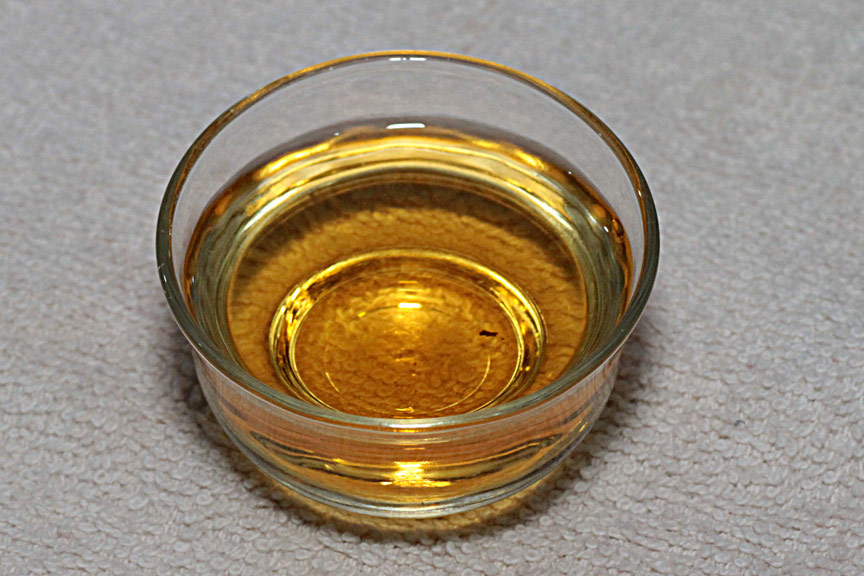
We used our Gaiwan teapot to make this first "official" unveiling of our own special green tea. As you can see, the tea came out a pale luscious and beautiful amber. The aroma was wonderfully hypnotizing with lots of hints of "hand-processing" and essence of being "hand-picked." Could it be that the freshmen all forgot to wash their hands as they picked our tea?Complex is simply a word that does not do justice to this "fantastic" tea.

As we both lingered over this exhilarating aroma, a hesitation gripped our solace. What if this stuff tastes bad? What if . . . .. . ? What if . . . . .? What the heck! We have just spent five days preparing for this moment and here we are hesitating.

As I sipped the hot liquid, the first thing that came to mind was . . . well, Zhuyeqing. Sunee's first comment was also - Zhuyeqing! Hey, that means that we were a success, doesn't it? A tea that tastes like Zhuyeqing is a good thing not a bad thing.

Actually this tea was quite good - not too bitter but with a nice sweetness that starts on the tip of the tongue and goes all the way back to the throat. It also possessed an aftertaste for a little longer than the normal Zhuyeqing. A very nice green tea, hand-picked and hand-processed on the slopes of Emei Mountain that screams out to anyone who dares sip of its youthfulness - I AM FRESH GREEN TEA.

Based on our experience as tea pickers and tea processors, are we ready for prime time? I think if one did the math, one would realize that tea from Emei can be bought for a whole lot less than the freshmen class paid for this tea. It cost 15 Yuan for each tea picker to go out and do the picking. There were 22 freshmen along with the Gap Guys and me doing the picking. The tea that Sunee and I, thus, processed cost an astounding 375 Yuan for less than 100 grams of processed tea. PRIME TIME? I think not.

Saturday, March 14, 2009

A Return to Zhuyeqing Garden

The Freshmen Class 1 invited the Gap Guys and me to go pick tea with them at the Zhuyqing Garden. Pick tea! Great idea.

Mr. Frank and Ms. Jennifer dropped by our apartment at 0900 on Saturday and we walked back up the hill to the Live Plaza where several of the freshmen were waiting for us and transportation. The Gap Guys, Jennifer and I took a rented car to the garden while the other students took a bus to Emei City and would get a taxi.


Here is Jennifer waiting for the car while we visit with the other students.

The Welcome Sign at the entrance to the Zhuyeqing Museum and Garden.


We had a good time introducing the Gap Guys to some of the other students as we waited for the rest of the freshmen to arrive.

The "koi" and gold fish were especially active this morning so I had to get several shots of them. They looked pretty hungry.

The Zhuyeqing Rock is always a good place to take a few pictures. Still waiting for the others to arrive, we looked for things to keep us entertained.

Finally the rest of the class arrived and Ms. Freda arranged for us to meet our tea lady who took us over to the tea plantation to pick our tea.


The tea lady, Ms. Yang, went around and helped us understand which tea leaves we needed to pick. Here she trains me on what to look for in picking tea. Do I have what it takes to be a professional in the tea industry? With her guidance, I may have a shot at it.

Ms. Freda picking tea as quickly as she possibly can. Actually she was not picking the tea that quickly. I looked into her bag a the end of the picking and I counted 42 leaves.

Bless his little tea picking hands - Admon.

More pickers slaving away at trying to fill up their tea bags.

If one looks closely, one can see the newly formed teabuds among the mature tea leaves.

Ms. Yang seemed to really enjoy training the "waiguo ren" as he attempted to become a professional tea picker. She could speak a little English and we had a great time trying to get me to understand what leaves to pick and what leaves to leave. Leaving the correct leaves seemed to be the key to picking the correct leaves. She was a delightful teacher.

This is what we were looking for according to Ms. Yang. One small leaf attached to the unopen tea bud. These were the best tea leaves to pick.

A great picture of a newly opened tea leaf.

Here two students are bothering me for pictures as I try to fulfill my destiny as a tea picker.

After an hour of picking tea, these three students got bored so they started taking pictures and having a good time. Tea picking is boring!

Here, Mr. Jack, joins the bored trio for picture taking and none tea picking activities.

More freshmen clowning around not doing their class activity of picking tea. Guess none will sign up to the advanced tea picking class coming up soon.

Jon, one of the Gap Guys, conned these students into picking the tea for him. I looked into his tea basket and he only hand 33 tea leaves. No wonder he had to have guards with him all the time.


Here are some of the guys on the other end of the tea rows. Notice their empty tea baskets and bags. No wonder there are no professional men tea pickers. Only women have the hands that are small enough to get to all the good tea buds. Only women have the ability to pick tea from dawn 'til dusk. Only women do not goof around and take stupid pictures. Women also work together with the others in the group and do not wonder far afield and clown around when they are supposed to be picking tea.

This is the official Freshmen Class1 Tea Picking Picture. I will print a couple of these out and have the members of the class sign it and then we will present them to the Gap Guys.

Here is the sum total of all the tea the class picked. The basket is really very small so there is not much tea in the basket. In fact, we did not have enough tea for the tea cooker to mess with. We will have to fry it ourselves. I eventually ended up with the tea for Sunee to fry next week after she gets back from Thailand.


Mr. Frank thinks the fresh-picked tea smelled really good. Or did he? I forgot to ask.

As we walked back to go through the museum, I took these pictures of some of the girls posing for pictures. Not too bad, huh?


Mr. Jack is overwhelmed by the aroma of the freshly picked tea. Or was he? Me thinks he might have been acting, which he is famous for doing.

Here Ms. Jennifer and Ms. Freda pose by a flowering tree. I kept asking what kind of tree it was or what kind of flower. All I got was that it was a PINK FLOWER.

One of the flowers identified as a PINK FLOWER!

Inside the Zhuyeqing Museum

I got to watch the show again and, again, I was not impressed with the length. The whole thing took about ten minutes. I did try to get some better pictures of the lovely lady doing the gaiwan thing which she does here.

This lady obvious has done this before. She pours the water from a pretty good distance from the gaiwan cup. Seen it before and actually done better at many of the local tea shops.

The Sichuan style of pouring water into the gaiwan. This demo lasted about three minutes. I tried to get some good shots but my camera takes longer than three minutes to get ready.

A porcelain figure representing drinking tea in China. Notice the tea stuff around the guy.

The Gap Guys, Jon and Dave, discovered that this wood thing was actually a giant tea pot. I missed this the first time around.

Dave here is doing a really lousy impression of the Sichuan style of pouring tea. He made it appear to be very painful. I fear he does not have a future in the tea industry.

Each exhibit had English translations for us foreigners to read. Here Jon checks out the English to find out what the heck the exhibition is about. Actually Jon was just looking blankly at the Chinese.

Ms. Freda does a very poor job of faking caligraphy. I tried to get her to be more realistic but it is obvious that she is a poor actress. Maybe she is a good caligrapher!

Shopping area in the museum. The tea here was not cheap. In fact, it was very, very expensive.


The "what is it, what is it" photo I had so much success with the week before with Giselle, Cecilia and Taunis. Same picture, different models.

The garden and museum was fun and educational. Afterward we got vans back to the university where we had a typical Emei Shan lunch. Kind of a hot pot thing with chickens and taro floating around in a spicy liquid. Not bad but the chicken was full of bones and took a lot of effort to eat.


A final picture of Ms. Freda enjoying our lunch.

Sunday, March 8, 2009

Thailand Doi Mae Salong No. 17 Oolong

As I mentioned in a previous post, I am very interested in the oolong tea now coming out of Northern Thailand. Specifically the tea that was produced at Doi Mae Salong.

Back in the 1980s, my Thai family and I made the trip to Chiang Rai and then on up to Mae Salong via the newly constructed road. It was a strange place with modern cars and fairly expensive looking housing. The people there were all Chinese and spoke Mandarin fluently. We walked among the buildings in the village (all pretty much on both side of the newly constructed asphalt road). We ate lunch at the main tourist building and visited with the sales ladies who were selling tea and other items, mostly Chinese. It was a strange experience because the ladies were certainly friendly but the men were rather scary. In fact, they all reminded me of the gangster movies from Hong Kong. These guys were bad, really bad.

We ended up buying three bags of their tea. When we got back to Bangkok, we found the tea to be really bad - almost fake tea. The people up at Mae Salong were not tea growers at this time and it was obvious that the whole thing was a scam to get the government off their drug dealing backs.

At that time, I did some research and found that this group of Chinese were the remnants of the Kuomintang's 93 Yunnan Division and were members of the 5th Army. They had moved out of Yunnan Province during the 1950s after NOT surrendering to the Red Army in Yunnan. In Burma they had become involved in the drug trade (opium) and were eventually forced out of Burma and into Thailand where they set up residence at Mae Salong around 1961. Their drug connections were still very much alive and well when we visited there.

I remember reading how the King of Thailand had worked with them to trade crops from opium to tea, cherries and other fruits. When we were there, we were told that these people had successfully used the program and were now honest tea growers. I did not believe it for a second! Their tea really sucked.

Now it seems after more than twenty years, they have become successful tea growers. Do a Google search about these Chinese Yunnanese and you will find that they have developed a pretty impressive tea. Seems they went to Taiwan and brought back some of the hybrid teas that Taiwan had developed and become famous for. Taiwan Oolongs are some of the world's best and compete favorably against the Oolongs coming out of Fujian.

Well, now it seems that these Chinese in Thailand have done exactly the same thing. I have read several articles which praised the Oolongs out of Doi Mae Salong and Doi Tung in Northern Thailand. When we went back to Thailand during the Spring Festival break, the tea from this area could be bought at several different locations. It was not cheap but reported about half the price of Taiwan's best. Sunee was not interested in it as she feels strongly that Thai tea (other than the traditional iced variety) pretty well stinks. She would not let me buy to try any of this tea. I did, however, steal a few grams from her sister who had paid nearly 900 Baht for a very small bag of it.

Now I have heated the water up and have tried this tea. It was labeled Number 17 from Mae Salong. Research found that this Number 17 is the hybrid number from Taiwan and is Thailand's best tea along with Number 12. Let's see just how good this Thai tea really is.


The tea looks like the standard oolong from Fujian or Taiwan. The smell was fresh and the color was a deep green.


Up close, the tea looked to be tightly wrapped and quite heavy. Again the color looked really good and it was obvious that the tea was fresh and well preserved.


I used my little teapot to make the tea, rinsing the leaves once before pouring the boiled water from my water pot. The first infusion was rather light but pleasant. The second and third I left in for about a minute and the result was superb. This tea is good! Really good. I got no hint of astringency and the front and back tastes and sensations remained pretty much consistent throughout my drinking experience - smooth and tasty. The liquor was a honey golden color and did not darken much even with longer infusion times. The taste became stronger with the longer times but the color was pretty consistent.


This is the second infusion and was very refreshing. Something tells me this is a great tea and the price indicates this as well.

I did not think I put much dry tea in my little pot, but when I emptied the pot into a small cup, the teapot was jammed full of the leaves. The spent leaves were huge and mostly unbroken. They were also very shiny and bright. Once more, Thai tea from this area is as good as any I have tasted from Fujian. Kind of nice having a good tea being grown when one plans to eventually retire. Try this tea. You will not be disappointed.

Saturday, March 7, 2009

A Trip To The Zhu Ye Qing Museum and Gardens

About a week or so ago, one of my students mentioned about a tea museum in Emei City. They were not sure exactly where it was so thought I would find out. My Freshman Writing Class #2 had a local Emei City student studying at Jiaoda so thought I would ask her.

As the students were working on an assignment, I asked Cecilia about the tea museum and she immediately volunteered to take me there. Two other students excitedly volunteered to go with us: Mr. Taunis and Ms. Giselle. We decided to meet at around 10 AM on Saturday (March 7) to catch a bus to Emei City and then take a taxi to the museum. All of us seemed to be greatly excited about the prospects of visiting the museum. Could it be that the Mists of Emei had been causing us some depression? For me this was most definitely true.

Saturday morning I got a call from Sunee concerning her return tickets. Seems we purchased a return economy instead of the expected business seat as we were led to believe. This little oversight meant that she could not get an earlier flight home and had to wait until Sunday. She was upset and wanted me to get someone to call the travel agency. I told Sunee I was going to see some students at 10 AM and I would take care of it.

Since Giselle, Taunis and Cecilia were more than capable of helping me get to the bottom of this "mistake," we all decided to go to the travel agency first. It was only a few meters from the bus stop.

The travel agency had some minor remodeling done and I almost did not recognize it. Between me and the three students we explained the situation to the agent. She did not perform impressively and it took about a half hour or more to finally come up with the answer - the return ticket was indeed an economy ticket. The question thus was why were we charged so much money for a business travel and an economy return. The agent, only an employee, could not help us so I said we would see her again on the 15th when Sunee got back. Taunis was convinced that we had been cheated. We shall see!

The Zhu Ye Qing Tea Museum and Garden

After getting frustrated by the ticket agency, we caught a taxi to the gardens.


The taxi to the museum was 7 Yuan and there seemed to be quite a number of tour buses parked outside. The welcoming sign was in both Chinese and English and gave a decent description of the place.

My three student guides anxious to get started as they pose for the opening photographs for this blog.

Hey look, Mr. Taunis yelled at us, this is the way to the museum. Was he reading the Chinese or the English?

This is the obvious Zhuyeqing rock as the brand name was prominently displayed on it. Zhuyeqing is both the name of the tea and a registered trademark of this big tea company. Makes for some confusion, especially for the none locals. Cecilia explained the situation to me very easily. Zhuyeqing Company charges five times more for their tea than does the local vendors for the same tea. I understood that fairly quick!

On the way to the museum, there was a row of bronze statues on both sides of the walk. I liked this teapicker so thought I would share her with you.


I also like the Sichuan-style tea server. I had heard about these guys so was hoping to see one in action today.


The entrance to the museum was obvious so we went up to check it out. The cost to get in was 5 Yuan so I bought our tickets. We all received a little cup of Zhuyeqing to try.

This is the ticket to the museum. Always a nice souvenir in China.

As we walked in, the ladies at the entrance told us we were just in time to see the tea demonstration so we hurried to the auditorium to watch. Of course, it was a Chinese Tea Ceremony.


It was ok but way to short. In fact, the whole thing did not even take fifteen minutes. It was a big disappointment plus I had seen better demos up close and personal.


As we walked out and followed the small crowd of visitors, we came to a large room with antique furniture. Must be a typical Chinese tea sitting room. So Taunis and Giselle sat and posed as appropriate on the chairs.

Around the room on the tables were tea stuff. Most of it had cracks or broken pieces. This teapot was very large and probably pretty useless because of its size.


Since we were in a tea sitting room, I figured I might as well sit for a photo as well.

Don't forget me! Don't forget me! Cecilia yelled as she sat in the sitting chair with her favorite bunny in hand.

The wall was covered with Chinese tea stuff so thought I would snap a picture for the blog. Believe the Chinese characters are for respect and humility or some such thing. For sure the one on the right is "respect."

The Museum

The next part of the building was the tea museum. It was small, nicely laid out but does not compete with the tea museum in Jia Jiang. Most of the stuff was rather drab and uninteresting. Might as well take some pictures since I am here.

I really liked this plaque so I took a picture of it. Believe I will try to find one like it for our Chinese compound in Thailand which we plan to build.

This is a root that grew (or was trimmed) to look like the Chinese character for tea - "cha."


Bet there are lots of teapots in here? Don't bet against it because there were. This weird one looked to be made of bamboo.

Another plaque that would fit well into a Chinese compound located in southern Thailand, don't you think?


This was an interesting display that caught my attention. The large teapot was rather simple but refined and I loved the "cha" that shows on the book next to it.


Bet there are some teacups in this museum. Yep, I was right. This one had some buddhas inside and outside and looked to be very old.

Teapot anyone? Lots of interesting teapots on display.

All the exhibits had a professionally laid out explanation board next to them in both Chinese and English. Throughout the museum, one saw these bilingual information posters. Now that is a good idea for all of us foreigners.


Now here is a weird teapot! As I looked at it, I finally figured out what the thing in the back was - a spoon to scoop out the tea and put it in the pot. Actually, this was really a very attractive pot.


As we walked through the rooms full of museum stuff we came to a room set up for calligraphy. Nicely laid out. Once more Cecilia checks out the seating and even does some calligraphy for the photograph. She, of course, forgot that the brush needs to have ink on it to work.

Moving on we came to an area that was entitled Sichuan Scenes or something like that. I call this photograph - SPOUTS. These are the water spouts that the sichuan tea servers used.

I call this photograph - The Pour Idiot.


Both Giselle and Taunis do a much better rendition of the sichuan tea server.


Here Cecilia and I pose in front of the typical Sichuan tea place for a picture. Notice that Cecilia loaned me one of her pet bunnies to hold in my hand. She always seems to have bunnies whenever we take her picture.


How are you? I am fine and you? Taunis greets his teacher and they pose for a photograph in OLD EMEI CITY.


Nice pose of Giselle and Cecilia. Unfortunately for Cecilia, her bunnies must have been hiding in her pocket.


Looking closely at the display to try to figure out what it is. Right, ladies?

Interesting old BW photograph of a typical street scene in old Emei City.


Path to the Garden

We leave the museum and follow the path that leads to the tea garden.


Weird, over-sized teapots sat along the path on both sides. Most were boring but this guy was different so I snapped his picture.

What is it? What is it? Yelling for me to take a picture, I immediately obliged their frantic yells. Well, "it" was nothing more than a teapot with weird things on its lid.

Zhuyeqing Garden

The garden was very Chinese (who would have thought!) and lovely.

My three guides pose for a picture just as we enter the garden. They are anxious to show me what Chinese gardens are all about.


All "real" Chinese gardens have water be it a pond or a running river. This garden was no exception with a beautifully laid out pond and buildings.

All Chinese gardens have a bridge of some sort. This bridge looked great with the surrounding architectural forms.


Here is another view of the garden with pagoda, pond and the surrounding architecture forms again.


The Tea Plants

The tea plants. The tea plants. Where are the tea plants? Cecilia was anxious and excited to show us the tea plants so she asked one of the attendants. Straight ahead on our left - we can't miss them.

An information sign telling us about the famous Emei Mountain zhuyeqing tea. Of course, the Zhuyeqing Tea Company zhuyeqing tea is by far the best!


Rows upon rows upon rows of tea. Me thinks this is not real as the zhuyeqing tea is supposed to be high up on Emei Mountain. Do you want to bet these are tourist tea plants?


And finally here is a little zhuyeqing waiting to be picked. See the bamboo leaf shape of the young leaf just now coming out.

Sunday, February 22, 2009

Jiaogulan Herbal Tea

I spend too much time on the internet researching teas. Ask Sunee. She will tell you the truth.

During one of these "trips on the internet," I came across something call Jiaogulan tea. The Chinese was xiancao or longevity grass. The stuff I found stated that some good examples of this tea were being grown in the mountains of northern Thailand. Great. Here is something I can pursue while in Thailand, knowing that buying quality Thai tea would be forbidden.

At a small organic shop not far from our home, I came across a cute little tin of the Jiaogulan Herbal Tea. It was not cheap - 130 Baht or around $4. At least for Sunee, this was expensive since it only had 50 grams. Hey, I thought the cute little tin was worth the four bucks!

Here is the front cover. Kinda classy looking, don't you think?

The back of the tin gave the information necessary to fix this up for drinking in both Thai and English. Very professionally done.

From this net: http://www.jiaogulan.net

Chinese: xiancao (仙草, literally "immortal grass"; more accurately "herb of immortality")
English: five-leaf ginseng, poor man's ginseng, miracle grass, fairy herb, sweet tea vine, gospel herb

History of Jiaogulan
Chapter II

(from Jiaogulan "China's Immortality Herb" by Michael Blumert)

Traditional Uses

Although jiaogulan grows in many Asian countries, there does not seem to be any early historical documentation in existence other than in China. The earliest information available on jiaogulan dates back to the beginning of the Ming Dynasty (1368-1644 A.D.), when Zhu Xiao first described the plant and presented a sketch of it in the book Materia Medica for Famine in 1406 A.D.. But he recognized it only as a wild crafted plant used as food or a dietary supplement during famine, rather than as a medicinal herb. Later, about 1578 A.D., the renowned herbalist Li Shi-Zhen also described jiaogulan in detail and with a sketch in his classical book Compendium of Materia Medica. He pointed out that this herb could be used to treat hematuria, edema and pain of the pharynx, heat and edema of the neck, tumors and trauma. This was the earliest record of jiaogulan’s use as a drug, although at this time it was confused with an analogous herb, Wulianmei. However, in the Qing dynasty (1644-1912 A.D.) Wu Qi-Jun in his book, Textual Investigation of Herbal Plants, cited the description and sketch from Zhu Xiao’s book and added more information about its medicinal usage. He also clearly separated jiaogulan from its confusion with Wulianmei. Jiaogulan’s traditional use has not been widespread in China. It was used as a folk herb in the local areas where it grew wild. Jiaogulan grows mostly in the mountainous regions of southern China, far from the central part of China, an area which has long been known as the “ancient domain of China”. This central area of China is where the classical system that we call traditional Chinese medicine (TCM) evolved. For this reason, jiaogulan is not included in the standard pharmacopoeia of the TCM system, and therefore has not had as widespread use as TCM herbs. However, an experienced TCM practitioner in China has analyzed jiaogulan and described its qualities in terms of traditional Chinese medicine, as “sweet, slightly bitter, neutral, warm, enhancing ‘Yin’ and supporting ‘Yang’”, and suggested that “it would be used to increase the resistance to infection and for anti-inflammation.”

Modern Discovery

Jiaogulan has been used by the people in the mountainous regions of Southern China as an energizing agent. They would take it as a tea before work to increase endurance and strength, and after work to relieve fatigue. It has also been taken for general health and has been recognized as a rejuvenating elixir. People also used it for treating common colds and other infectious diseases. Hence, the local Chinese people called jiaogulan, xiancao the “Immortality Herb,” and described it thus: “Like ginseng but better than ginseng.” Another story states that in a village near Fanjing Mountain in Guizhou province, the inhabitants would drink jiaogulan tea instead of the more common green tea and as a result many people there were living to 100 years of age. In 1972 the Research Group of Combined Traditional Chinese-Western Medicine of Qu Jing in Yunnan province did a study on the therapeutic effect of jiaogulan in 537 cases of chronic tracheo-bronchitis. This was the first report of medicinal usage of jiaogulan in modern Chinese medical literature. Jiaogulan has since been included in the more recent Dictionary of Chinese Materia Medica, where it describes the traditional uses for jiaogulan as a medicine. There it is indicated for anti-inflammation, detoxification, cough remedy, as an expectorant and as a chronic bronchitis remedy. Other traditional uses as a medicine have been anecdotally said to be for heart palpitation and for fatigue syndromes. In Japan, jiaogulan is called amachazuru. “Amacha” means “sweet” in Japanese, referring to the sweet component prevalent in the plant, “cha” means tea, and “zuru” means “vine”. The name perfectly describes the jiaogulan plant, which grows as a climbing vine and produces a sweet tea from its leaves. Amachazuru has been recognized in Japan since the late 1970s, and its description and uses are included in the Japanese Colour Encyclopedia of Medicinal Herbs. Among other things, it is stated there: “Because of the sweet taste of the leaves, it has been used as a mountain vegetable”, similar to its use during the Ming Dynasty mentioned previously. Perhaps one of the more significant revelations about jiaogulan came about in Japan in the mid-1970s. Previously unknown as a medicinal herb, jiaogulan’s discovery in Japan came about like many of the world’s great discoveries—partially through the hard labor of a dedicated scientist, and partially by accident. It all started like this: In the 1960s there was a trend amongst some research scientists to find an alternative sweetener to sugar. Although saccharin was in use for many years, they were still pursuing other sugar alternatives. In Japan, the government had prohibited the use of sodium cyclamate, a recently discovered artificial sweetener. Japanese researcher Dr. Masahiro Nagai, presently a professor of Pharmacognosy at Hoshi Pharmaceutical University, recalls:

I had been in the National Institute for Health (NIH) in the U.S. for two years, from 1969 to 1971, when Dr. Osama Tanaka, a professor in the Dept. of Medicine of Hiroshima University, sent a request to me asking that I send a copy of a thesis on Stevia, which had been a subject of research in the NIH. He was interested in the plant for his study as a safe sweetening agent, which is not a sugar. When I went back to Japan, I decided to study the ingredients of another plant, called amachazuru, for possible use as a sugar alternative which, because of my background in Pharmacognosy, I knew to contain a sweet component.

Upon analyzing the sweet component, he stumbled upon the first discovery by the scientific world of chemical compounds contained in amachazuru that are identical to some of the compounds found in Panax ginseng, yet in a completely unrelated plant. He announced his findings at the twenty-third Meeting of the Japanese Society of Pharmacognosy in 1976, at Hiroshima. As it turned out, there was no further investigation of the herb for its sweetness. At that time, another Japanese scientist, Dr. Tsunematsu Takemoto, whose specialty was herb medicine research, was seeking natural treatments for cancer and other ailments arising from stress, as well as a sugar alternative. His interest of study was in a Chinese fruit, botanical name Momordica grosvenori, a melon of the Cucurbitaceae (cucumber or gourd) family, known not only for its sweetness, but also for its medicinal uses. His interest in this fruit had been piqued because of its reputation as the “precious fruit of longevity” and as a popular Chinese medicine. After returning from an unsuccessful trip to Kenya in search of the Momordica fruit, he learned of the research being done with amachazuru, an herb in the same family as the fruit he was studying. According to Professor Nagai, “One year after my presentation of the study at the Pharmacognosy Society (1977-78), Prof. Takemoto and his research group saw my reports on the study of amachazuru, and became very interested in studying it.” Since the compounds in amachazuru were found to be similar to those in Panax ginseng, and because it was growing wild in the fields and mountains, Dr. Takemoto thought that he had possibly found, in an apparently insignificant perennial weed, an inexpensive and readily available health panacea, right in his native country.10 Upon analyzing the amachazuru himself, Dr. Takemoto discovered that it contained four kinds of saponins exactly like those in Panax ginseng and seventeen other kinds of saponins very similar to those in Panax ginseng. Over the next ten years he and his group of researchers identified and named eighty-two saponins from amachazuru, whereas Panax ginseng has been found to have up to 28 saponins. Although these two plants are not related, they contain the same major components: saponins, a substance that has the unique quality of dissolving both in water and oil, and when mixed with water and shaken, will foam up. In Panax ginseng the saponins are called ginsenosides, in jiaogulan, or amachazuru, they are called gypenosides. (See Chapter 5 for a more detailed explanation of saponins) Dr. Takemoto was very excited about this newly discovered herb and he embarked on a mission to gradually uncover all of its potential. Throughout the 1980s, Dr. Takemoto, along with his staff, performed studies which isolated and identified eighty-two saponins, which they simply numbered 1-82. In 1984 they performed three experiments that began to demonstrate amachazuru’s many health-supporting and medicinal qualities. They saw that amachazuru increased the activity and strength of mice in a swimming test, showing the herb’s ability to improve endurance. Another study on mice showed the herb’s effectiveness as a neoplasm or tumor inhibitor,15 and a third showed the herb’s ability (adaptogenic) to prevent the unpleasant side effects of dexamethasone (hormone treatmen).16 These studies used mice as subjects; nevertheless having been tested on mammals, they were a significant marker for the herb’s possible effectiveness on humans. This was borne out by subsequent studies on humans. Jiaogulan would prove, in studies, to enhance endurance, inhibit tumors and help protect the cellular immunity in humans, as well as provide many other health-promoting benefits. Although the Japanese findings were significant, they were only the beginning of the extensive research that would be done on amachazuru. Unfortunately, in 1989 the driving force behind the ground-breaking research, Dr. Takemoto, passed away. As a result, the energy to pursue the research significantly slowed in Japan. However, interest in jiaogulan by Chinese researchers was growing rapidly, sparked by the results of a nationwide population census taken in the 1970s. The census revealed that, in small regions in the south central portion of China (some villages of Guangxi, Shicuan and other southern provinces), high rates of people per capita were living to 100 years of age. Cancer incidence was extremely low among the inhabitants as well. Scientists from the Chinese Academy of Medical Science in Beijing and other institutions began to research these regions and discovered that the people living there were regularly drinking a tea made from the herb jiaogulan. Because of the significant results of the census taken in China during the 1970’s, and then the boom of scientific interest in jiaogulan (amachazuru) in Japan during the 1980s, many research studies on jiaogulan were undertaken in China, and they have been continuing up to the present. Various pharmacological and therapeutic effects of jiaogulan were investigated and proven by tests on animals and human beings. Tonics and recipes made of jiaogulan have been developed and are being used in Chinese medical institutions. Surveys of the resources of jiaogulan in various portions of China have been made and cultivation techniques investigated. Nearly 300 scientific papers on jiaogulan or its saponins have been published in respected journals, and information about the herb has been formally collected and published in the modern Dictionary of Chinese Materia Medica. Jiaogulan has been recognized and accepted by ever-increasing numbers of Chinese people. From the time of the Qin Dynasty (221 B.C.), the Emperors of ancient China would send various envoys overseas to search for the “elixir of life”, but their efforts were always fruitless. Perhaps, the “elixir” has been found by descendants of the Emperors, growing in their own homeland!

The leaves were delicately dried and twisted and oh so tiny and light.

A closeup reveals how green the tea is and how tightly each little leaf was twisted. These weigh almost nothing so the 50 gram turns out to be quite a lot.


The finished product. The tea is bitter at first but cannot compare to the Kudingchas that we have been drinking. The bitterness is quick and as one swallows the tea it immediately becomes a syrupy sweet sensation. Weird! The taste is strange and one immediately knows that this is not tea but some kind of Chinese herbal medicine. The taste is not unpleasant but weird keeps coming to mind. Weird it is and weird it will always be.

IMHO, this stuff is medicine and I would have to be a seriously believing Westerner to drink it as such. WIll it make me live longer? Maybe. Would the weirdness each day be worth an extra day or two in my life? Ahhh, that is the question. This stuff is so weird that it would probably mess up my taste buds to where I would not be able to taste all the green tea I must drink over the next year so I can start over with a new batch. PASSSSSSSSS!

Saturday, February 21, 2009

Tea In Thailand

Our trip back home to Thailand had little to do with tea. Thai oolong tea, however, is now being sold just about everywhere one looks. I have read several articles about this tea and how it is competing with the best from Taiwan and Fujian. The tea was planted about twenty years or so ago by members of the Fifth Kuomintang Army that moved out of Yunnan when the communists took over China in 1949. I remember visiting them at MaeSaLong a long, long time ago when the road to their mountain top hideout was first opened. I found the people to be less than friendly and the tea to be terrible. It was reported that these people were heavily into opium crops and the Thai army looked the other way. The King of Thailand did some crop swapping and encouraged them to plant tea. That tea is now coming on the market in a big way and some experts compare it favorably with oolong tea elsewhere.

I tried to get Sunee to buy some for me to taste but it was expensive, very expensive. I did talk my sister-in-law out of about 50 grams to try later on when I get the time.

In the meantime, I was forced to make do with Thai iced tea and Thai iced coffee. Wooo is me! Wooo is me! Who does not love Thai iced coffee and Thai iced tea. The coffee especially reminds me of Bryers Coffee Ice Cream back in the States. It was wonderful.
Tom came to visit so we took him to see some of the local temples. Lunch included some Thai ice tea and Thai ice coffee seen here

Unfortunately about a week after we got back to China, we got a call informing us that Sunee's brother-in-law had suddenly passed away. He was only a year or two older than me and this came as a complete shock. Sunee left to go back to Thailand almost immediately! Makes one realize how tenuous life really is.