Saturday, February 21, 2009

Tea In Thailand

Our trip back home to Thailand had little to do with tea. Thai oolong tea, however, is now being sold just about everywhere one looks. I have read several articles about this tea and how it is competing with the best from Taiwan and Fujian. The tea was planted about twenty years or so ago by members of the Fifth Kuomintang Army that moved out of Yunnan when the communists took over China in 1949. I remember visiting them at MaeSaLong a long, long time ago when the road to their mountain top hideout was first opened. I found the people to be less than friendly and the tea to be terrible. It was reported that these people were heavily into opium crops and the Thai army looked the other way. The King of Thailand did some crop swapping and encouraged them to plant tea. That tea is now coming on the market in a big way and some experts compare it favorably with oolong tea elsewhere.

I tried to get Sunee to buy some for me to taste but it was expensive, very expensive. I did talk my sister-in-law out of about 50 grams to try later on when I get the time.

In the meantime, I was forced to make do with Thai iced tea and Thai iced coffee. Wooo is me! Wooo is me! Who does not love Thai iced coffee and Thai iced tea. The coffee especially reminds me of Bryers Coffee Ice Cream back in the States. It was wonderful.
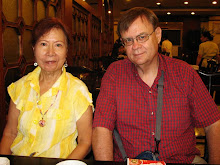
Tom came to visit so we took him to see some of the local temples. Lunch included some Thai ice tea and Thai ice coffee seen here

Unfortunately about a week after we got back to China, we got a call informing us that Sunee's brother-in-law had suddenly passed away. He was only a year or two older than me and this came as a complete shock. Sunee left to go back to Thailand almost immediately! Makes one realize how tenuous life really is.

Friday, January 9, 2009

Puerh Menghai Lang He Chi Tse Beeng Tea 9599

We visited the new Focus Market in downtown Emei City yesterday to buy a few chocolates for Thailand. In addition, Sunee bought her sister a cute little teapot, a little bigger than the one I got. Many things were on sale for the upcoming Chinese New Year. One of the items on sale that caught my attention was a Puerh Cake I had seen each time we had visited the market. It was on sale for less than half price so we bought it to try. As one of the tea bloggers (can't remember who) stated - buy puerh that you like. Here is my take on this puerh.

This is the cake we bought. This particular cake cost 56 Yuan or 58 Yuan depending on where you buy it in the local department stores. We bought this cake for 28 Yuan which is about half the normal price. We thought we would give it a try.

I am totally clueless about Puerh Tea. I do not understand what I am reading when I do research on the internet. I have only bought a few interesting cakes and I do like them very much. I will only buy puerh that I like per the blogger expert's advice.


What are we looking for in a good puerh? I don't have a clue. The cake we bought last time in Chengdu had a bunch of silver leaves. In fact, it was almost entirely light colored leaves throughout. Believe that is what is known as "tippy." It means the tea leaves are new and young. As you can see from the this picture and the following one, this cake has almost no "tippy" to it. They are all dark.

I understand that the leaves are oxidized then steamed and then pressed together to make the cakes. The process differs depending on what the final outcome of the tea is meant to be. What is the final outcome of this tea? Clueless!

The only thing that counts is the end product or the tea that one plans on drinking. The end product in this case made us go back and get three more of these cakes while they were still on sale and before we go to Thailand. Had some more of this puerh when we got back from buying the three cakes. It is good and that, so all the puerh people will tell you, is all that matters.

Wednesday, January 7, 2009

Keemun Black Tea

I bought this tea as one of the "famous" teas I wanted to try on our last trip to the Chengdu Tea Culture Street. I bought it along with a Dian Cong to give them both a try. We bought 500 grams of this Qimen tea and 250 grams of the Dian Cong since I already had the Yunnan Golden Tips, I figured they would be about the same.

I retrieved the following information from the internet:

The Processing of Black Tea

The processing of black tea requires a full oxidation of the leaves. After the leaves are plucked, they are laid out to wither for about 8 to 24 hours. This lets most of the water evaporate.

Then the leaves are rolled in order to crack up the surface so that oxygen will react with the enzymes and begin the oxidation process. The leaves are left to completely oxidize, thus turning the leaves to a deep black color. After that, a final drying takes place. From there, it goes off to be sorted, graded, and packaged.

 Keemun black tea (Qi Men Black tea), is 0ne of the most famous black tea in the world, also called Qi Men Gong Fu or Qi Men Oolong. Be assessed as the chempion of rea tea in the world match of tea in Panama in 1915.

Keemun blacktea has been praised as 'one of the best three high aroma teas in the world and the 'the queen of fragrance'. This one is the special grade of super high quality. The rich brown liquor with a slightly scented flavour and the bright amber infusion has an appetizing honeyed sweet aroma while the taste is wonderfully smooth and with a light hint of floral aftertaste win its distinctive name 'Keemun Flavor'. Also, because of its subtle and complex nature, it is considered as the'burgundy of teas'.


This particular tea is supposed to be the "mother" or "father" of most of the tea sold throughout the world.

Black Keemun tea has its place amongst the ten best known Chinese teas despite its relatively short history. It has been produced in the district of Qimen in the prefectship of Huangshan Shi in the An Hui province since 1875, where formerly only green tea was produced. “Keemun” is an English transcription of the Chinese “Qimen” from the colonial era, and it is rightly considered the “champagne amongst black teas”. Its taste is distinctly suggestive, fruity with a hint of grape, with a woody base, generally unrivalled and may be very subjective. Its aroma is sometimes compared to the scent of orchids or roses, it is floral to fruity with a flavour of coniferous wood plants (similar to Lapsang Souchong). Black (or more accurately red) Keemun tea, as one of a range of Chinese teas, won an award at the international Panama-pacific exhibition in 1915. The production procedures for this tea are fully in accordance with the strict norms of USDA/NOP-Final Rule for the production of organic foodstuffs.

The Qimen tea leaves are black and very similar to the Yunnan Golden Tips. The Dian Cong (Dian actually means Yunnan) I bought was almost exactly the same as the Yunnan Gold Tips I have already been drinking. The main difference was the amount of golden leaves in the mixture. The Yunnan Golden Tips tea had almost 100% golden leaves while the Dian Cong tea was about 40% to 50% golden leaves. These Qimen leaves are almost all black with an occasion goldish leaf.

Here you can see the Qimen tea leaves that I used to get six solid infusions from. I probably could have gotten a couple more, but I was in a hurry to get this on this blog.

The first infusion was lighter than the second and it contained all the flavors mentioned above in the internet write-up. It had hints of the American Lipton tea but a level one hundred times better. It was strong and flavorful without being astringent but I never did get any hints of what I would call floral. This is nothing like Puerh floral and, IMHO, does not match the Yunnan Golden Tips in flavor or in the subtle nuances of the great teas I have been drinking. I think this tea would handle any amount of milk or sugar one wanted to throw at it. It is solid and strong with a mild front taste and a lingering but not overpoweringly strong aftertaste. I can see why people add stuff like flowers and things to it. The flavor is not overly abundant but honest and smooth all the way through from teeth to throat. Solid seems to be the term that keeps coming to my mind.

I let the second infusion go for about three minutes and it came out darker and even more subtle with its flavors. This is a great tea if one likes the taste of "Western-style" tea. It tastes exactly like a more expensive and more powerful tea from a Lipton tea bag. Same flavor but more pronounced and much more genuine. Maybe I have drunk too many cups of Chinese tea, because this is not my favorite. I understand its strengths and why it is the "mother of all Western teas," but still I prefer the Yunnan Golden Tip black tea. To me the Golden Tip tea is almost chocolaty in its flavor whereas this is just tea flavored. It was, however, well worth the trip to Chengdu and I think Sunee will put some honey in it to get the black tea benefits. An experience well worth repeating now again.

Tibet Sweet Tea

I received some Tibet Sweet Tea from my Tibetan student, Ms. Trysa. She is one of the few Tibetan students we have here at Southwest Jiaotong University-Emei Branch and I was very excited to have her in my Freshmen Writing Class. She is absolutely a beautiful woman, I was surprised by her gift. Although I have been drinking this tea for breakfast off and on since Christmas, I thought now would be a good time to introduce it to you.

During the Welcome Freshmen night, Trysa performed a traditional Tibetan dance in Tibetan costume. She was wonderful!

This is the "chop" on the top of the box of instant Tibetan Sweet Tea.

No need for me to copy this off the box to let you know what is inside.

The box contained ten packages of instant Tibetan Sweet Tea. I think I have around five left.


The bags are typical instant tea bags and are easily opened and very convenient to use.

The sweet tea is great for breakfast and especially if one likes coffee with cream and sugar. The tea is almost the flavor of chocolate and certainly has the color to match the flavor. Overall, this is a really interesting tea and probably gives one a "taste" of the Tibetan sweeten tea. I bet it is close to the famous "Yak Butter Tea" I have heard so much about. Any one ever try the "yak butter" tea?

Tuesday, January 6, 2009

Punishing the Tea Traitors


The peaks of Emei do not call to me
Neither can I look upon their beauty
Nor do I walk in the forests in awe
For today like yesterday is cold and raw

The teas on her slopes drink in her mist
Oh, yes her green teas are hard to resist
Two weeks on and the mists remain
For humans it is nothing but a pain

Crying out for the mountain to cease
The mist and rain and give us peace
She laughs at us and continues the pace
Of mist filled air and water in the face

Her beautiful temples do not beckon me
Stay away from rocks for they’re slippery
The cold is real and cuts to the bone
Hey, I know this because I’m not alone

She’s scolding us daily this great mountain Emei
Making us pay for not drinking her tea each day
It’s three weeks since we’ve seen the sun
Living in her shadow is not much fun

Kindly stop this cold mist from coming down
Making us miserable here on the ground
We promise to drink only your wonderful tea
Please stop the cold mist and give us some liberty

Saturday, January 3, 2009

My First New Tea of the New Year: Xin Yang Mao Jian

On our last trip to Chengdu, we bought this tea pre-packaged to give it a try. I had read that it was considered one of those "top ten Chinese teas" I keep reading about. The price was around 8 Yuan for 100 grams and I had to get it to try.

The following is a quick compilation of several sites (mostly commercial tea sellers) that provide information about this tea. I read them all and then put together the information.

Xin Yang Mao Jian

Xinyang Maojian is produced in the top of Xinyang, Henan Cheyun mountain, Jiyun mountain, Tianyun mountain, Yun wu mountain, Zhenlei mountain, Hei Longtan, Bai Longtan and other mountains. The end products' color is green, the pekoe revealed. The color of tea is bright-green, the fragrance is thick, the flavor is good and the leaf bud strong, light green even.

This Xinyang area has a superior climate and earth soil conditions ideal for green tea production. A couple of thousand years of perfecting the manual system tea craft, causes "the Xinyang Maojian" to be unique and unequalled. Tea Saint Lu Yu in his "the Book of tea", stated that Xinyang Maojian is the high-grade tea, Song Dynasty big literary giant Su Dongpo also placed " Huai Nan tea Xinyang first " among great teas of China.

Xinyang Mao Jian attained the famous tea high quality certificate in 1915 at the Panamanian international exposition; In 1959 it was listed as one of ten big famous teas of China. In 1982 it was, once again, evaluated and given the ministry-level high quality famous tea of China.

Though Xinyang is on the edge of the arid North China plain, the mountainous southern and western parts, crisscrossed by streams and brooks, have plenty of the clouds and mist needed for good tea. The processed leaves are in fine, taut strips. They make a delicious tea with a chestnut flavour and a long-lasting aftertaste. This tea was produced with only very simple equipment. What makes it different is the skilful hand movements of rolling, adjusted to the heat and softness or dryness of the tender leaves.


Front of the package.

From the back of the 100 gram package we bought:

Xinyang maojian lies in mountains of Xinyang with densely covered rivulet and fog. It is finely made by tender bud as raw material. It is adopted traditional craft and modern science and technology to produce. It owns features of elegant and slender shape, peak green, little white, clear green in water, fine aroma, special style. It is special tea titbit.

The back of the package contained the above description and date of production. It states that this tea can be stored for around 18 months.

Ok, enough preparation for this tea. Let's find out how it tasted

The tea looks pretty much like the other Mao Jians we have tried from Emei Mountain and elsewhere. It was dark green and twisted nicely together. It looked to be about the same density as the Emei Mao Jian.

My close up shot reveals nothing out of the ordinary. This tea looks like any other Mao Jian one can buy locally.

And, of course, the proof is in the cup. This tea is good, really good. Since we bought it pre-packaged, one can probably figure it to be a lower grade of tea than one could buy in its loose-leaf form. Nevertheless, this tea is great. It is smooth with a full-bodied sensation and a sweet and fairly long lasting aftertaste. The word "cooling" comes to mind whenever I take a sip. We really like this tea and when we go back to Chengdu, we plan to stock up on it.

I did about five infusions before it ran a little weak. Do believe if I let it set longer, I could have gotten a couple of more infusions. A truly great green tea worth drinking regularly.

Sunday, December 28, 2008

Happy New Year 2009

Hope Unsurpassed

As the mists of Emei fly
Across the endless Sichuan sky
And we approach this year’s end
With all the things we had to contend
I hope the new year brings you
Joy under brilliant skies of blue
Wealth beyond belief
Health for your relief

As the cold of the region settles in
And winter bites your reddened skin
I hope you have a warm and joyful place
To celebrate the New Year to embrace
Those you love as well as those you like
Forgetting those you hate and want to strike
It is my desire in hope unsurpassed
That I am one of the first and not the last

Wednesday, December 24, 2008

A Merry "Mao Feng" Christmas

It's Christmas Eve and we are set for at least three different parties. My sophomore class number three will be having a Christmas party at 1550. I have been having Christmas parties in my classes all week. A great way to do Western culture! So far I have attended four parties with yesterday's two classes combining to have one party. It was great fun.

Today after the class party at 1550, we have been invited to celebrate with the Dean and other faculty members with a dinner at 1800. Finally, at 1930 the students of the Foreign Language Department will have their party. So little time, so many parties.

My good friend Bogdan (an American here who has a computer software company) had his wife drop by to give us a huge tin of Huangshan Mao Feng. Another of those "top ten classical teas of China." I could not wait so we opened it and tried it.

Weiyan, Bogdan's wife, brought the tea in this bag. Obviously it came from a Huangshan place.

The actual tea was housed in this huge beautiful tin. We are talking a lot of Mao Feng here!


The Mao Feng tea leaves were a lot bigger than the Emei Mao Feng. One of these days, we will sit down and do some serious comparison of the Mao Feng and other teas.

Close up, the leaves are various shape with some having hair and others just folded nicely. This Mao Feng also has a lot more green to it than the stuff we buy from Emei.

I used my new pot and Induction Tea Cooker to make this Huangshan Mao Feng. The results were excellent. This tea lives up to its reputation easily. It is a bit heavier than that coming form Emei but also sweeter with more delicate undertones. Once again, who would not like such a fine tea as this? It is truly a great tea.

I did five infusions with these leaves but really only got two good cups of tea. After the third steeping, the tea was pretty weak and lost any meaningful sensations. Green tea is only good for two and, at the most, three infusions.

Saturday, December 20, 2008

Menghai County Raw Puerh Tea

On Saturday, we made the trip down to Focus Market after dropping a watercolor painting off to our friends who have the Chinese medicine store. We had the painting framed to give as a Christmas gift. At focus, we bought several more packages of tea to give away in Thailand and I bought this tea to try it out. It only cost around 9 yuan for 60 grams. That comes to about one dollar and thirty cents. We had tried a "raw" puerh in Chengdu and love it. Even bought a bing cake of it we liked it so much. I hoped this puerh would be a choice that would bring us joy. The price certainly was right.

This is the packaging of this puerh. Attractive and convenient, it stood next to all the green teas that one sees everywhere.

The leaves look like puerh, smell like puerh and are, indeed, puerh. Nothing fantastic to see, just plain puerh processed tea leaves.

Up close the puerh leaves look and feel like smoking tobacco. The wrinkles are the same and the color is identifical. I sure wish I understood puerh better than I do now. I get confused whenever I try to read an article about its history and processing. Makes me want to go visit some puerh factories in Yunnan.

The actual liquid from the leaves was disappointing. The puerh tea we had in Chengdu was much lighter. This tea is OK but it is what one would expect from a decent puerh tea. Nothing outstanding, just a good drinkable tea. Sunee does not like it because it reminds her of the Tea she sees in Thailand. I, however, really enjoy a good cup of puerh, especially when it puts my cheeks to sleep as it often does.

As one can see, the leaves are mature, dark and heavily textured. Guess that is what makes them puerh, right?

Liu An Gua Pian Green Tea

Liu An Gua Pian or Melon Seed/Pieces green tea is considered to be in the top ten (maybe even top five) great Chinese classical teas. I had been reading about this tea for several months so when we went to Chengdu this past week, we bought some.

The Melon Seed/Pieces tea is the result of a labor intensive picking style in which the farmers cut the pointy tip end and woody stem of each leaf creating indentically sized "melon pieces". Lu An Gua Pian is made only using the tea leaves and no buds at all (similar to Japanese green tea). The emerald-green dried tea leaves are long and narrow, each measuring between 1.5cm to 2cm in length. The long leaves are thin and soft creating a rich flavor without bitterness. Only the first, second and third tea leaves are used to produce this tea. The leaves are withered to reduce leaf moisture and then baked and simultaneously rolled to stop oxidation while frequently turned to impart a delicate hint of smokiness. This also gives the tea its unique melon seed shape.  The tea then goes through several drying processes requiring the skill of an experienced tea master. After drying, the tea is sorted, winnowed to remove broken tea and then graded.  This tea originated in Anhui province in 1776 during the Ching dynasty.

The dried leaves are easily identified from other greens. The leaves are dark to grayish green, long and tightly closed. They have by far the longest tea leaves of any green tea we have tried thus far.


Up close, one can see the darkened texture and the folded dried leaves. Once again, the leaves are easily identifiable.

The liquid is a beautiful golden yellow, light and transparent. The taste is fantastic. Sweet, mild and not a hint of bitterness. It has a unique floral taste and a long aftertaste much like that of Tie Guan Yin. The pleasant floral sweetness, if that is what it is, fills the whole mouth with a very refreshing and smooth sensation. These really good teas always remind me of drinking the pure water from the artesian well not far from where I grew up in Oklahoma. There is a purity in the taste that one feels more than tastes. Wow! One can see why this tea is in the top ten famous teas list. It is wonderful beyond belief!

Here you can see the Gua Pian leaves after being infused four times. One cannot really get much more than four steepings from these leaves and I think this is probably true of most green teas. The fourth infusion was rather weak and lost the beautiful golden yellow color.

Quick Trip To Chengdu Tea Culture Town

Since we were planning to return to Thailand in January, we decided to take a quick trip to Chengdu to buy some tea for Thailand. We left on the 0800 school bus and arrived at SW Jiaotong University in Chengdu at around 1040. We immediately caught a taxi to the Tea Culture Town and found the area shops we had done business with before.

The trip into Chengdu was foggy and cool, almost cold. As usual, Emei Mountain was putting out her usual misty morning skies.


One of the first things we did was to check out the Liu An Gua Pian. I had been reading up on this famous tea and definitely wanted to give it a try. Here we are buying the tea after successfully negotiating for a discount on bulk.

The leaves of the Gua Pian are the most unusual we have ever seen. Guess this must be way they have their name - Melon Seed or Melon Pieces.

How about a little sample to wake you up in the morning. Nice flavor and nice aftertaste. One can see why this is in the top five teas of China.


Sunee and I are both very happy with our purchases from this shop.

Our next stop was to find the tea accessories shop from our last visit. The lady we bought the last batch of tea from walked us over to the area where the store was. The store is on the second floor so we returned, bought our Induction Tea Maker, two big Giawans, my new better teapot and some other items.

This is one of the two huge Gaiwans we bought to use daily. It cost 6 Yuan (less than $1 USD) and is really big, bigger after we bought it and got it home than even we realized.

This is the first "expensive" teapot I have purchased. The one in the previous posts cost a whopping 2 Yuan at one of those Two Yuan stores that have popped up in Emei City. This was several times more expensive and if one compares just the pictures of the two teapots, the difference is obvious. I will have to wait for my REALLY expensive teapots until later.

We originally wanted to buy four cup mats (is that what they are called) to match our tea tray. Sunee said she want four (si4) of them. When we got home and checked over our receipt, we realize we had been charged for ten of these mats. Instead of 3.5 Yuan times four, we found we had 3.5 Yuan times ten. Speakers of the Sichuan dialect and virtually all southern Chinese speakers have trouble with the reflexive sounds in Chinese. Four thus sounds to them like ten if a none native Chinese mandarin speaker says these two sounds. Ten is the pinyin shi2 but actually sounds like si2. At least it does to me and obviously to Sichuan speakers as one sees them clarifying the four and ten with the fingers crossed for ten. Sunee obviously did not cross her fingers. As it turns out, we are now both happy to have bought ten of these cute little mats to use around the house.

We are also the proud owners of an Induction Tea Cooker. This keeps the cups and such warm while rapidly heating the water via induction in a nice teapot. It works really great. I have it setting next to my computer and am looking at it as I type this. The cost was 180 Yuan or about $26 USD. Well worth the money!

On the way back to the main road to catch a taxi to the Walmart closest to Southwest Jiaotong University, we met this lady when I stopped to look at her collection of Yixing Teapots. She specialized in Puerh from Yunnan so we talked with her about buying some more cakes. She suggested a young puerh cake she had just received. We decided to give it a taste.

In addition to the young puerh cake, we found two different kinds of puerh in these two smaller cakes and decided to buy them for 15 Yuan each (around $2 USD). One was cooked while the other was not cooked.


This is the puerh cake that the lady showed us and told us about. Sunee bargained until she got it down to 75 Yuan (about $11 USD).

We were very impressed with the tea from the above tea cake. It was not as dark as what we expected and the taste was just marvelous. Now Sunee thinks we should have bought several of them. We bought one plus to two small cakes to take back to Thailand with us.

All together we bought the following teas on this trip:

One Puerh cake
Two small Puerh cakes
Liu An Gua Pian tea
Xihu Longjing tea
Dian Hong tea
Qi Men Hong tea
Xin Yang Mao Jian tea
Jun Shan Yin Zhen tea
Bi Luo Chun tea


After our tea culture town journey we got a taxi to Walmart where we bought a CD/cassette player for the Buddhist Nun we have been teaching English. She works and lives a FuHu Temple about a fifteen minute car ride from Jiaoda. This should assist her learning English. To learn more about this nun and the FuHu Temple please go to:

emeimtn.blogspot.com